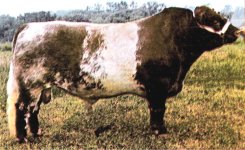
dutch belted

Steer Planet - Cattle, Steer & Livestock Forum

Help Support Steer Planet:

knabe

Well-known member
Joined
Feb 7, 2007
Messages
13,648
Reaction score
10
City & State/Province
Hollister, CA
http://afs.okstate.edu/breeds/cattle/dutchbelted/

saw a few bulls this breed at stud this weekend.

kinda cool.

one guy is trying to save the germplasm/breed.


The American Livestock Breeds Conservancy now lists Dutch Belted as on the critically rare breeds of livestock in the North America, with fewer than 200 registered cattle in the country. The breed in the U.S. is the only source of pure belted genetics in the world since the Lakenvelders in Holland suffered from much crossbreeding from 1950 to 1976. In fact breeders of Lakenvelders in Holland have turned to American Dutch Belted Breeders several times since then for semen from pure bulls.
 
They were of course brought to Scotland and crossed with the Galloway to create the belted Galloway.
 
The Hoffman family in Illinois has been preserving a grazing herd of dutch belted and milking shorthorns for several decades. They also offer a fair amount of semen on bulls of both breeds.
 
There are a few Dutch Belted herds in the USA.  The number posted of less than 200 registered animals is incorrect as the largest herd in the World is in California and they milk over 1,000 head.  We have over 100 of their Dutch Belted bulls listed on our website.

The herd in California also bred and owned the highest classifying Dutch Belted cow.

Here is an article about the owner - Ron Pietersma.  https://edepot.wur.nl/462831

The Netherlands also has Dutch Belted / Lakenvelder.  They have been working on trying to do a BBR test to determine the purity of some of the animals.  Yes the USA has exported semen to the Netherlands and we have gotten semen and some embryo's from them.

http://dairycattleregistry.com/dutch-belted-bulls/
 
Something that is interesting to me is how many of the old roan bulls show a vestigial belt pattern. Once you see it, you can’t un-see it. As I understand it, from work on mice, belted, roan and lineback patterns are all determined by (dis)regulation of KIT expression during melanocyte development and follicle pigmentation that occurs in waves during embryogenesis. Leader 9th, for instance.
 

Attachments

  • CFEF1622-E479-41E7-A1E7-085305235FCC.jpeg
    CFEF1622-E479-41E7-A1E7-085305235FCC.jpeg
    139.2 KB
librarian said:
Something that is interesting to me is how many of the old roan bulls show a vestigial belt pattern. Once you see it, you can’t un-see it. As I understand it, from work on mice, belted, roan and lineback patterns are all determined by (dis)regulation of KIT expression during melanocyte development and follicle pigmentation that occurs in waves during embryogenesis. Leader 9th, for instance.
I had a Homedale Blizzard 820 daughter with a band like that on only one side. She went 4/5 siring calves with the band on the opposite side, and the only calf without was solid white.
 
As an Amazon Associate we earn from qualifying purchases. Product prices and availability are accurate as of the date/time indicated and are subject to change.
Duncraggan said:
Do they produce A2 milk?

The herd in California has tested many of his and especially the bulls and yes many of them are A2A2
 
California, A2 milk, maybe he has a niche product here. Well done!
Love it when farmers play into the hands of these internet health/healthcare specialists.
 
Leader 9th passed that marking on a lot of the time, mostly on the right side.  Scotch Shorthorns often had a belt in the heart area, and it was not considered a desirable color.  At the local 4-H show a belted roan won grand champ for me twice, and a reserve grand for our daughter.  Sometimes the belt was reason enough that he was not kept for a bull. 
 
Back
Top